

Canada’s Wood Waste Could Supply Five Times Its Jet Fuel Demand, SUSTAERO Finds
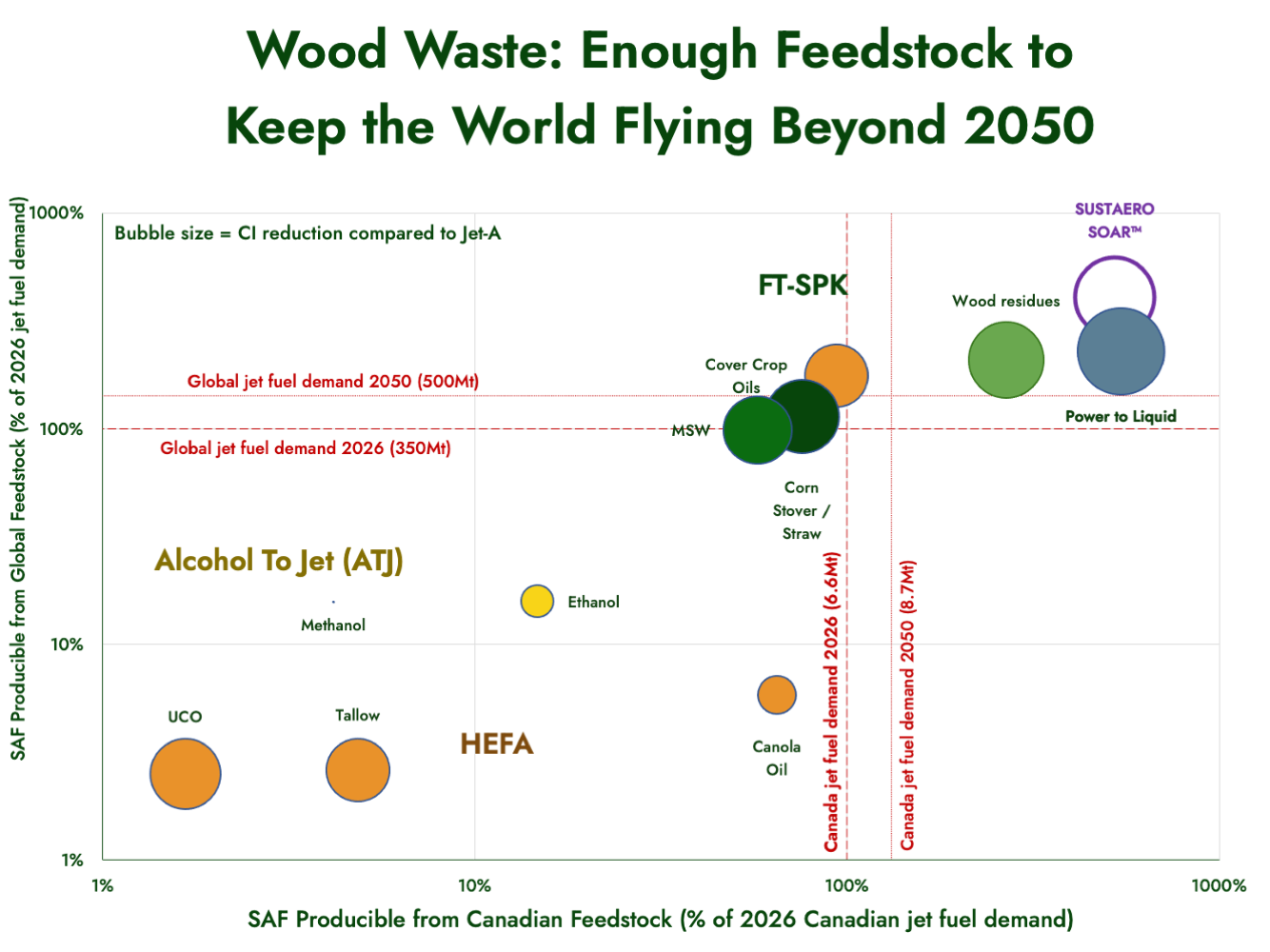
Each gridline marks a tenfold increase. Bubble size indicates availability of Canadian feedstock. Bubbles right of the red dashed lines exceed Canada’s jet fuel demand; bubbles above the horizontal lines exceed global demand.

SUSTAERO logo

SUSTAERO CEO Keith Gillard addressing the Sustainable Aviation Futures North American Congress
Report released at AFCC conference finds hydrogen-enhanced conversion is key to unlocking Canada’s low-cost forest residues.
The white paper evaluates global SAF feedstocks and finds that while the fats and oils used in Hydroprocessed Esters and Fatty Acids (HEFA) face severe supply limits, wood waste is the single largest feedstock available to decarbonize global jet fuel.
“Meeting global SAF targets requires moving beyond scarce lipid feedstocks to abundant, sustainable ones,” said Keith Gillard, CEO of SUSTAERO. “By pairing Canada’s managed forest residues with low-carbon electricity, we can economically produce drop-in jet fuel with 90 percent lower carbon intensity and position Canada as a premier global fuel exporter.”
Key Takeaways from the White Paper:
- Feedstock Scale: Canada holds close to 9 percent of the world’s forests. Converted via conventional gasification and Fischer-Tropsch (FT) synthesis, Canada’s gross wood waste could supply more than two and a half times current domestic jet fuel demand.
- Hydrogen Doubles Yield: Adding low-carbon electrolytic hydrogen through SUSTAERO’s proprietary Syngas Optimization for Aviation Renewables (SOAR™) process roughly doubles fuel yield per dry tonne, enabling Canada’s logging and uncommitted mill residues alone to supply more than five times current domestic jet fuel demand.
- 90 Percent Lower Carbon Intensity: Powered by low-carbon, hydro-dominated grids, hydrogen-enhanced wood-to-SAF achieves a 90 percent reduction in lifecycle carbon intensity (CI) compared with fossil jet fuel, as independently calculated by Brightspot Climate.
- One-Fifth the Feedstock Cost: On an energy-adjusted basis, clean wood waste costs approximately one-fifth as much as HEFA feedstocks such as used cooking oil or tallow, avoiding the price pressure and supply ceilings facing lipid pathways.
- Lessons from Legacy Failures: The paper finds that past first-of-a-kind biorefinery failures stemmed from contaminated feedstocks, such as municipal solid waste, and custom technology integration. SUSTAERO mitigates both by using clean wood residues and commercially proven licensor technology at Technology Readiness Level Nine (TRL-9), the highest level.
The release comes as Canada proposes amendments to its Clean Fuel Regulations (CFR) that would give SAF produced in Canada from North American feedstocks an effective 1.8-times credit multiplier (an 80 percent top-up in compliance credits).
Keith Gillard, CEO and Co-Founder of SUSTAERO and author of the paper, will present its findings today at the Alternative Fuels and Chemicals Coalition (AFCC) Global Biobased Economy Conference and later this week at the Sustainable Aviation Futures North American Congress in Houston, Texas.
The full white paper, Wood Waste: Canada’s SAF Feedstock Advantage, can be downloaded after registering at www.SUSTAERO.ca.
About SUSTAERO: SUSTAERO aims to be the world’s first billion-litre wood-waste-to-SAF producer. Built by a team with Fortune Global 500 experience, SUSTAERO uses its proprietary SOAR process to integrate decades-proven TRL-9 technologies, converting forest or sawmill residues and low-carbon electricity into eSAF and bioSAF. The result is a secure, long-term supply of jet fuel with 90 percent lower carbon intensity. Please visit www.SUSTAERO.ca to learn more or contact PR@SUSTAERO.ca.
Forward-Looking Information: This news release contains forward-looking information, including statements about SUSTAERO’s plans, projected production capacity, fuel yields, carbon intensity, feedstock availability and costs, and the expected effect of proposed regulatory changes. This information is based on current expectations and assumptions and is subject to risks and uncertainties, including technology performance, project financing, feedstock supply, regulatory outcomes, and market conditions, that could cause actual results to differ materially. Readers are cautioned not to place undue reliance on forward-looking information. SUSTAERO undertakes no obligation to update it except as required by applicable law.
###
Keith Gillard
SUSTAERO
+1 778-919-0436
Visit us on social media:
LinkedIn
Instagram
Facebook
YouTube
X
Legal Disclaimer:
EIN Presswire provides this news content "as is" without warranty of any kind. We do not accept any responsibility or liability for the accuracy, content, images, videos, licenses, completeness, legality, or reliability of the information contained in this article. If you have any complaints or copyright issues related to this article, kindly contact the author above.
